
One of the joys of this role is getting a glimpse into a whole slew of industries and wearing a different hat every week. One week we’re learning about the nuances of LLM context windows and the future of AGI, and the next week we’re channeling our inner tweens for potato chip inspiration. This kind of variety gives us unique insight into the ideas and brands that are springing up all the time, in real time.
In this series, I’ll be offering up a snapshot of what we’re seeing lately: industries in focus, naming news, or anything else that’s catching our attention here at AHM.
Intelligence table stakes
These days, the majority of our projects have an AI component—meaning the brand or product in question features some form of AI integration. Of course this is nothing new. We’ve witnessed a steady influx of AI projects over the last decade (one of my first projects at A Hundred Monkeys was naming Abridge back in 2018, which is now one of The World’s Most Innovative Companies of 2026).
During that time, we’ve watched AI become a buzzword plastered on every billboard along I-80 in San Francisco. We’ve fielded questions from potential clients about our level of AI expertise and assured them that the name doesn’t need to have “A” and “I” in it. We’ve followed how its ubiquity has impacted software trademark registration.
Today, the presence of AI is implied in pretty much any tech initiative, so shouting it from the rooftops doesn’t have the same impact as it might’ve ten years ago.

AI as infrastructure
Samsung is a longtime partner of ours. In their most recent Unpacked event, where they unveiled the new Galaxy S26 lineup, they referred to AI as “infrastructure”—something deeply embedded in the mobile tech experience and no longer seen as a novelty, but rather an expectation. The word “infrastructure” feels especially fitting as Samsung expands its smart technology beyond the home—into cars, ships, and community spaces.
When systems like Galaxy AI and Apple Intelligence were introduced in 2024, they were positioned as providing cutting-edge experiences that would only be available on more premium devices. Now, those experiences are available on budget and mid-range phones and built into every mobile moment. In another two years, it’s easy to imagine AI becoming even more embedded into everything the internet touches, becoming a fundamental layer in the fabric of our relationship with technology.
What this means for naming
Imagine if every AI-powered feature had a name like Apple’s Image Playground. “My phone automatically detects when I’m on hold, with the Call Continuum feature…” instead of Hold Assist. If everything is made to feel a bit special, then what really is special? Not to mention the cognitive load (and marketing spend) required to make dozens of fanciful feature names stick.
As a result, we’re glad to see companies leaning toward more descriptive or branded-descriptive names for their embedded AI features. Instead of Obscura Glass, there’s Privacy Display. Instead of Quiet Fluency, there’s Live Translation. The goal of this approach seems to be twofold: 1) help people navigate a growing ecosystem of increasingly specific features that live alongside each other, and 2) position the AI as helpful and convenient, rather than disruptive or intimidating. I recently wrote about the effect this has on major tech launches.

AI in marketing
Often when one of our naming projects ends, that’s when the work begins for an internal marketing team—the people who run testing, define messaging channels, and ultimately make sure the product will sell. So naturally, we’re interested in how AI touches their work, even if we’re not marketers ourselves.
Liam Humble, Senior Creative Lead, recently sat in on a talk titled “Reality Check: Building the new infrastructure of influence” led by global brand consultancy Siegel+Gale and Omnicom Media. Some of the key takeaways included:
- Trust is eroding not because of AI quality, but because of perceived deception
People react less to what AI produces and more to the feeling of being unknowingly misled. - AI works best when it’s useful and invisible, not expressive and front-facing
Adoption rises when AI improves the experience behind the scenes, and drops when it becomes the experience itself. - Authenticity + restraint + clarity are the new pillars of brand performance
In an environment of infinite content, brands win by being selectively present and operationally coherent. - Brand voice is shifting from what you say to how you behave
As AI systems act on a brand’s behalf, consistency of decisions matters more than consistency of tone. - The future favors brands that optimize outcomes, not attention
Long-term trust accrues to brands that help users achieve goals, not those that simply keep them engaged.
More than ever, the experience that a brand provides is more important than what it claims to be (via its name or supporting language). Similarly, how a brand chooses to use AI speaks volumes, and audiences are picking up on it. As namers, we can’t control how signals are sent, but we can help companies make a first impression that leads with humanity.

Palate cleansers
Every now and then we get the pleasure of naming a CPG (consumer packaged goods) brand. Interior (a multifunctional wellness juice), Victory Lap (a prebiotic drink mix), and Neap (a protein gel) are some of our favorites to have launched this past year. We love the CPG space because it comes with certain creative liberties that other industries don’t necessarily enjoy. Plus, it’s a chance to see—and experience—the name in real life.
Expo West 2026
Last month, the Expo West conference in Anaheim, CA featured thousands of emerging and familiar brands with a focus on natural products. Dieline was there covering all of their favorite packaging designs and rebrands. Here are some of the standouts from a namer’s perspective:
Social Spritz by De Soi
The De Soi (pronounced “duh swah”) brand of NA cocktails has opted for an English name for its upcoming line of spritz beverages. Social Spritz is a nice descriptive counterbalance to the poetic brand name, highlighting the main benefit of staying socially present.
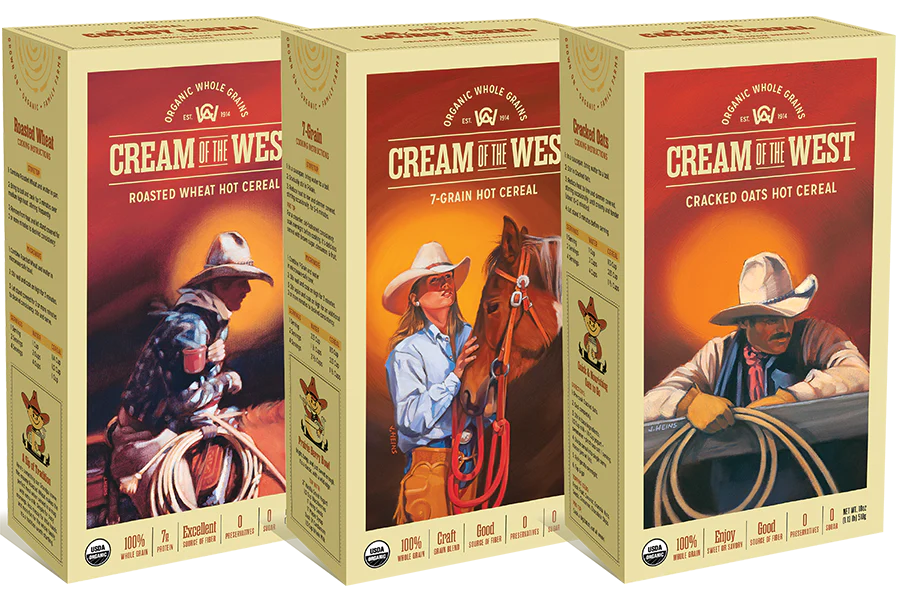
Cream of the West
With packaging design inspired by pulp fiction westerns, Cream of the West looks and sounds like a general store staple of yesteryear. The brand aims to bring back “trust in food,” and there’s something refreshing about resisting the urge to make oats exciting.
One Trick Pony
Peanut butter. That’s the trick—although their newly-designed tub (resembling more of a Gen Z beauty product) might be the second trick they had up their sleeve. Still, we appreciate brands that aren’t afraid of seemingly “negative” names like this one.
First Cut
Like Cream of the West, First Cut’s brand design taps into the Old West—possibly reflecting a broader appetite for pre-internet nostalgia. The name feels cinematic with a pioneering spirit, but mostly, it sounds like the crispiest chip you’ll ever eat.
Consider this a glimpse into the full naming gamut. On one end, AI becomes embedded infrastructure and naming leans more functional. On the other end, consumer brands take nostalgia to the extreme—and of course, it’s hard not to see the cause & effect.
For more updates on our studio, our client community, and what’s catching our attention, sign up to receive our newsletter.
Thanks to Liam Humble and Ben Weis.