The Life and Death of a Brand
You could say it went down not with a bang, but with a whimper. First, our studio’s go-to grocery store sold out of our favorite flavor. Then it was all flavors. Then it was all stores. Was this a supply chain issue, or was this, somehow, the end?
The meteoric rise of a local legend
There’s something darkly poetic about a brand named “Revive” that couldn’t survive its own success. When Peet’s Coffee bought a majority stake in the beloved Bay Area business in 2018, I have to imagine its intentions were pure. News reports stated that there would be no changes to the brand’s business strategy. With this new support, Northern California’s top kombucha producer was going to be able to overcome the precarity of startup life and scale across the country, including in Peet’s coffee shops.
By 2019, Revive was being rolled out nationwide to 8,000 7-Eleven stores, in addition to previous footholds in grocery and health food stores. For founding team Sean and Rebekah Lovett, who started the business at a farmers’ market stall in 2010 and once sold their cars to make payroll, this expansion was lauded as a homegrown success story.
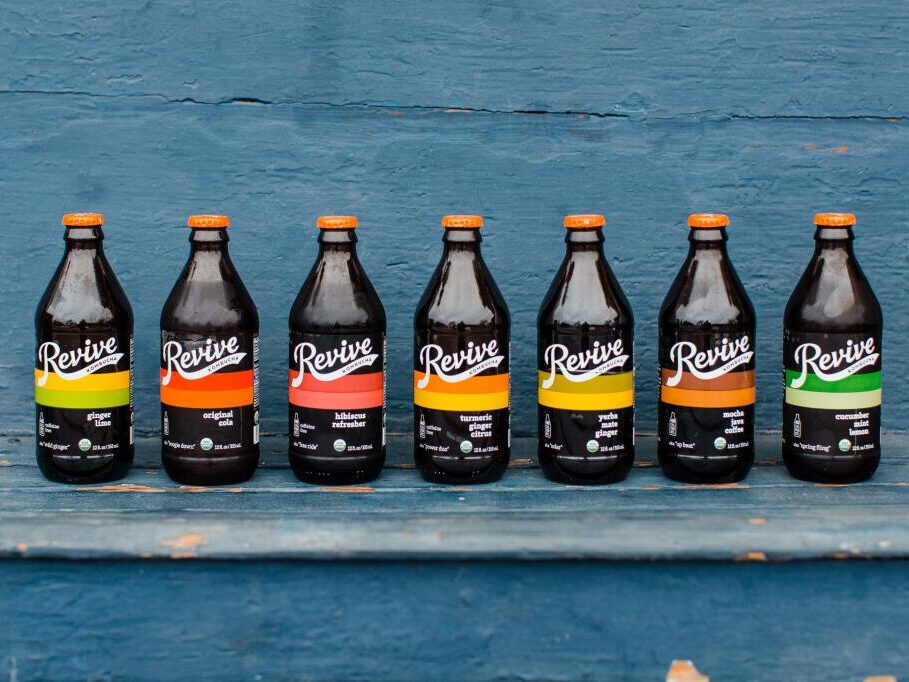
Their kombucha stood out in the market because it was made by someone who didn’t like the taste of kombucha—but valued the health benefits and wanted to stop drinking soda. It lacked the vinegary punch of most kombuchas on the market, and their “original cola” flavor was reminiscent of the good parts of soda, the hint of vanilla and spice, without being cloying.
So what happened? Was it the acquisition? Growing too big too quickly? The difficulties of running a business in California? High costs? Labor shortages? Power outages exacerbated by the climate crisis? The practical realities of making a product that is very much “alive” and requires certain controlled conditions during manufacturing and transport?
I have spent more hours than I would like to admit trying to figure out how a wildly successful beverage brand disappeared from the face of the earth. I’ve learned a lot about the brand’s rise, and about what made it special, but its demise is still shrouded in mystery.
Death by corporatization
The most likely culprit isn’t any single dramatic event, but rather the slow suffocation that often accompanies corporate absorption. When Peet’s acquired majority control, Revive became part of JAB Holding Company’s sprawling empire—the same Luxembourg-based conglomerate that owns Krispy Kreme, Panera, Pret A Manger, and Keurig Dr Pepper Inc. If this paragraph made you depressed, you’re not alone.
In this ecosystem, Revive was no longer the scrappy local favorite that the Lovetts could pivot and adapt on a whim. I can imagine it became a line item in quarterly reports, subject to corporate efficiency metrics and portfolio optimization strategies. The very qualities that made it acquisition-worthy—its authentic appeal, artisanal production methods, high quality ingredients, and devoted following—may have been incompatible with the operational demands of a large corporation.
Revive’s undoing coincided with what some see as kombucha’s golden age. With an explosion in popularity, kombucha has gone from a niche hippie health drink with maybe one or two brands on offer, to a mainstream beverage with tons of SKUs and countless flavors. They had the right product at the right time, but perhaps the wrong structure to capitalize on it. This captures the broader tension between authentic brand building and corporate scaling—you can have one or the other, but rarely both.
In the press release that accompanied the Peet’s takeover, Sean Lovett said all the right things:
“Our culturally aligned partnership with Peet’s Coffee, a beloved San Francisco heritage brand, will provide Revive Kombucha with a support system to fulfill our goal of reaching the millions of people demanding tasty and healthy beverage offerings. With this investment, we can continue our commitment to innovative individualized brew batches and natural fermentation methods to create unique kombucha beverages that spotlight the true stars of the show, our premium ingredients.”
But that’s not what happened. Before long, Revive phased out its refrigerated, bottled kombuchas altogether, pivoting to a portfolio of probiotic sodas that didn’t require refrigeration. I can imagine shelf-stable products look great in a quarterly report. But that assumes you no longer care about the people who actually matter—the folks who buy your drinks.
The thing about grief is that it doesn’t end. Death never “makes sense.” Even when you have a full breakdown of the time and likely cause of death, it still feels impossible. How could it be? Surely, there’s been a mistake.
What you’re left with is a longing for something that you could’ve sworn was right here just a moment ago. We still see trucks driving around the Bay with the Revive logo painted on their sides. A sign from the afterlife? A sign of a future rebirth? Like other avid fans who still comment on Revive’s social media posts years later—does anyone know what happened?! bring it back!—we can almost taste it.

