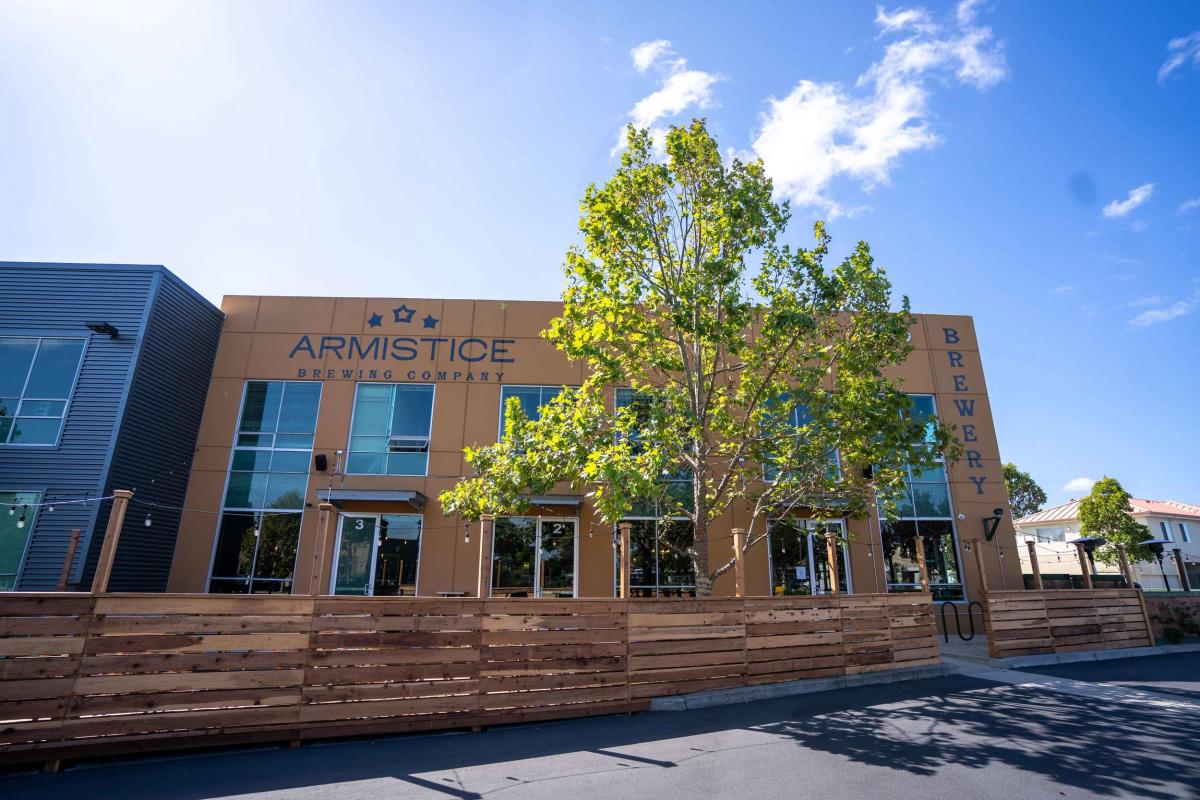
At A Hundred Monkeys we believe that employing humor in company and product naming is a good way into people’s hearts and minds. A jocular name can stand out in a crowded competitive landscape and communicate an intriguing story with levity or a wink. With nearly 9,000 craft breweries in the US, it’s an industry where clever and funny names can help smaller brewers make an impression. Co-founder of Armistice Brewing Company Alex Zobel and I sat down, over a couple of their latest beers, to discuss the nuances of naming beers with a hint of jest and a dash of satire.
When you began brewing professionally, did you think of the industry as being overly serious or self-pontificating?
That’s a really good question. Beer is marketed generally as a very democratic beverage and most people come to beer through a macro product from the “Big Four.” Beer has this very interesting tension between being widely available and accessible, and kind of striving aspirationally for prestige. That tension is just always going to be there.
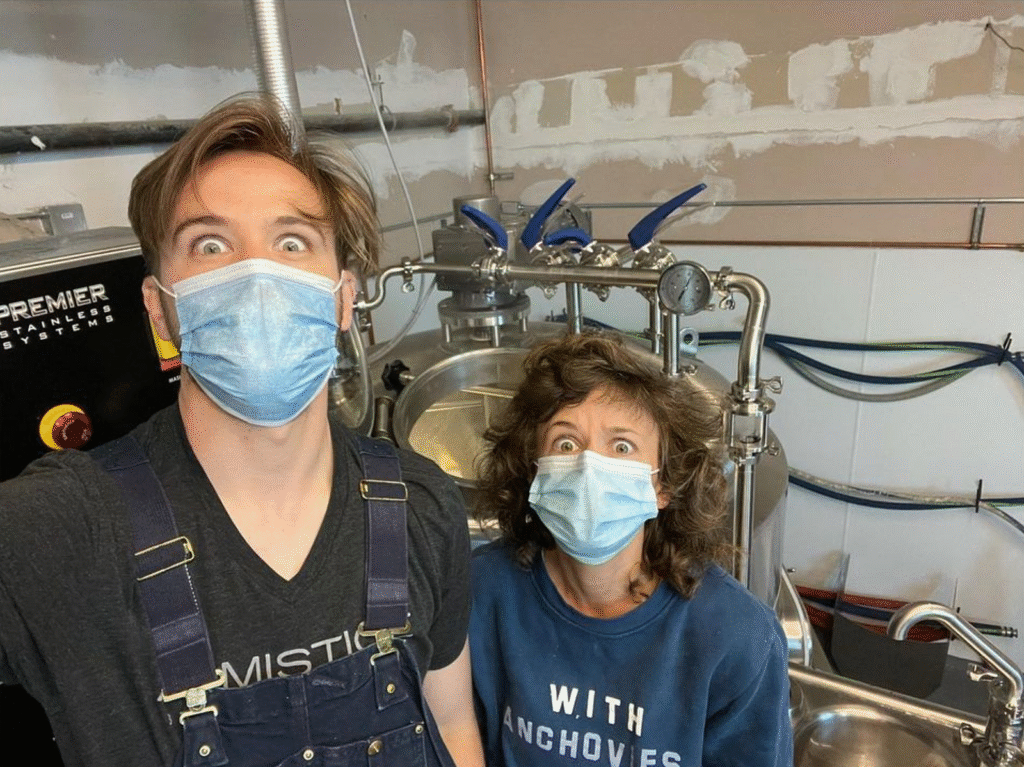
Does it take itself too seriously? Certainly, I think a lot of craft brewers do. At the same time, there’s always been the side of beer that’s whatever, dirtbag, fucking just crushing beer, shotgunning them in the parking lot. That tension is awesome and it existed before beer.
I feel like for us [at Armistice], because we’re not on shelves across America, we’re not trying to make a huge statement with every beer name. Sometimes, we do want to appeal to people who are more discerning. Other times we’re just trying to be a name on a list that stands out because it’s silly or in your face.
You mentioned “prestige,” which makes me wonder could a brewery that has humorous, self-effacing qualities be one that achieves a high level of prestige?
Yeah! Five years ago, at the Great American Beer Festival — in this case the criteria for “prestige” being winning a medal at one of the biggest beer festivals in the world. Figueroa Mountain Brewing won for a beer called “I Dunkeled In My Pants.” So low brow — not trying to impress anyone. I think maybe this is just more of a reflection of how saturated the market is. I don’t know if anyone’s looking for that beer right now. It’s a really funny name and it was a really funny moment, but I’m not sure that it had any lasting impact beyond that.
A dunkel is a type of dark German lager characterized by a smooth malty flavor.
I kind of feel that’s where we are in beer. It’s ephemera. It’s a funny, passing joke. I think Untappd actually helps facilitate that in some ways because it’s like a newsfeed, it’s not an archive.
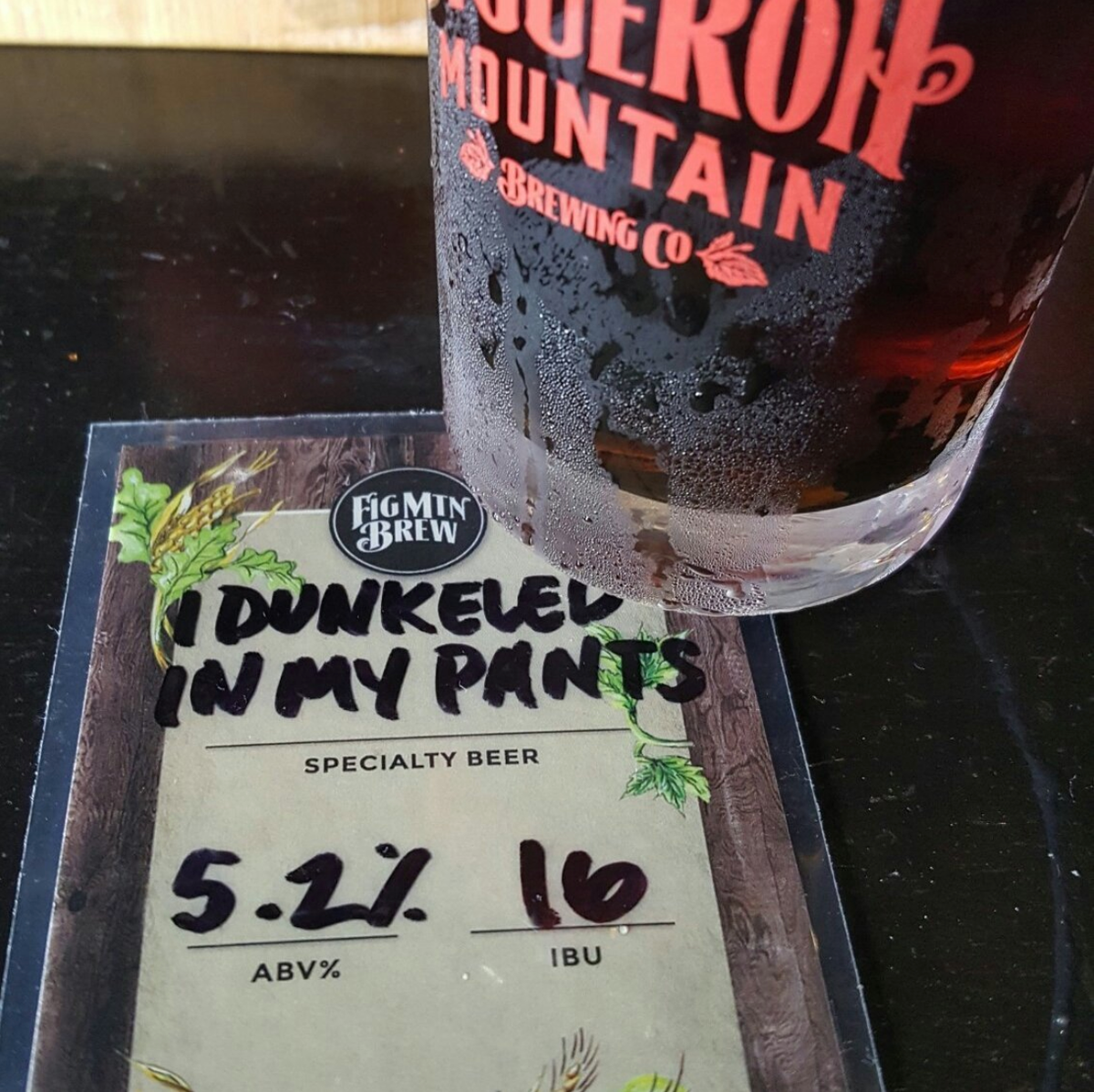
It seems like having an irreverent name, like “I Dunkeled In My Pants,” can garner attention, make an impression, but as far as a brewery’s success is concerned it’s just one piece of the puzzle?
Yeah, it’s like a game of small tractions. If this stupid name catches on with some people and they taste the beer and go beyond “I Dunkeled In My Pants,” and they find that they really like the brewery or some other obscure beer, and introduce their friends to it, and then they become lifelong fans, that’s great! That’s really great for a taproom-oriented brewery like ours. We’re just not in the big packaging, distributing game — it’s really different at that level.
In terms of Armistice taking ourselves too seriously, we try to distinguish two different kinds of labels. We have our bottled label series, which is really hearkening back to a more archaic style — the labels look like woodcuts, like they’re hand drawn, they look old-fashioned and beautiful. Then we have our canned series, which are more ephemeral, quick, funny, fast takes or quick hits.
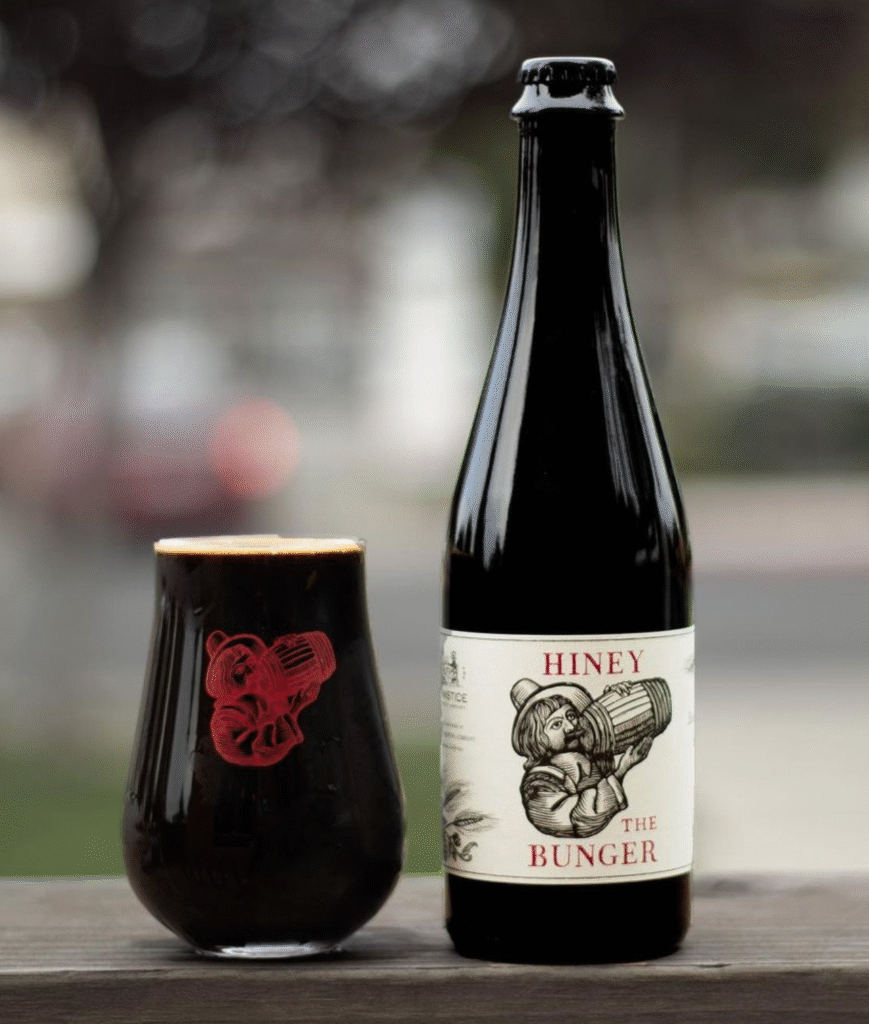
We really shat all over Russian River Brewing’s “Pliny the Younger” with our “Hiney the Bunger,” which I think was our first bottle. It’s already a poop joke and it’s poking fun at another brewery. We didn’t even do that good of a job trying to distinguish between the two. I personally feel like it’s a funny poop joke, but it’s so much more. It’s poking fun at Pliny the Younger and it’s the bunger, so it’s clearly barrel aged, but whatever.
I guess it’s fun to poke a giant. So how do you all name the beers? Is it mostly you and your co-founder (and brother) Gregory?
If someone on the brewing team has a good idea we’ll totally “steal” it. I feel like people like puns a lot. But, first of all, people don’t know what puns are! Just because it rhymes doesn’t mean it’s a pun. Assonance, alliteration, and consonance, those aren’t puns. It’s mostly me and Gregory, and honestly it’s mostly me generating ideas and Gregory just giving thumbs up and thumbs down. I have some resentments and I’m happy to go into those with you…
Yeah, it seems like you two sort of zigzag between naming styles or preferences. Is that the case?
I feel like I have a list of actually really great beer names for different reasons, but I feel like every week, Gregory is like, “I made another Hazy IPA, what’s it going to be named?” At this point I know the sort of name that Gregory’s going to like, and it’s what I would describe as pretty basic.
I think “Space Billionaire” is a great name and would’ve been even better when Elon Musk and Richard Branson were in their pissing contest. I think that would’ve been a great, ephemeral name. It’s a pretty good name in general, like it would last even if you don’t get the reference. But Gregory didn’t like it because it felt too political. That’s usually why my beer names get canned.
No pun intended.
Yeah. I don’t think we’re an interesting company because of this, but I think the fact that our beer is introduced to people in a lot of different contexts makes the naming process — and the context in which the name is received — just really different. You could be experiencing “Space Billionaire” on a shelf at Berkeley Bowl and have no context, and I would have to assume that whoever’s designing our label is going to communicate a concept that makes sense for the name and the language.
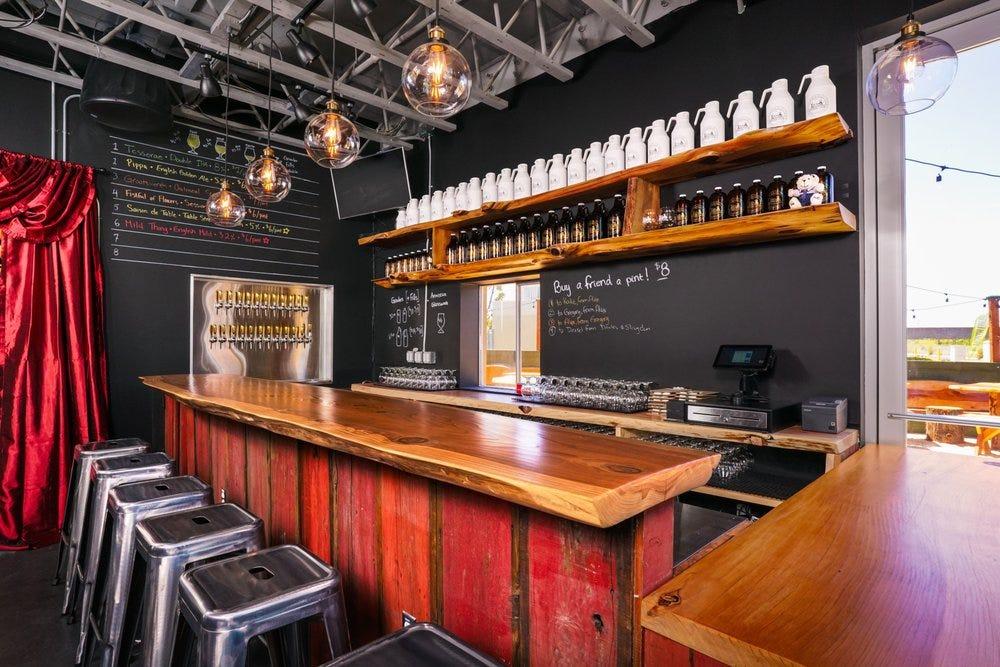
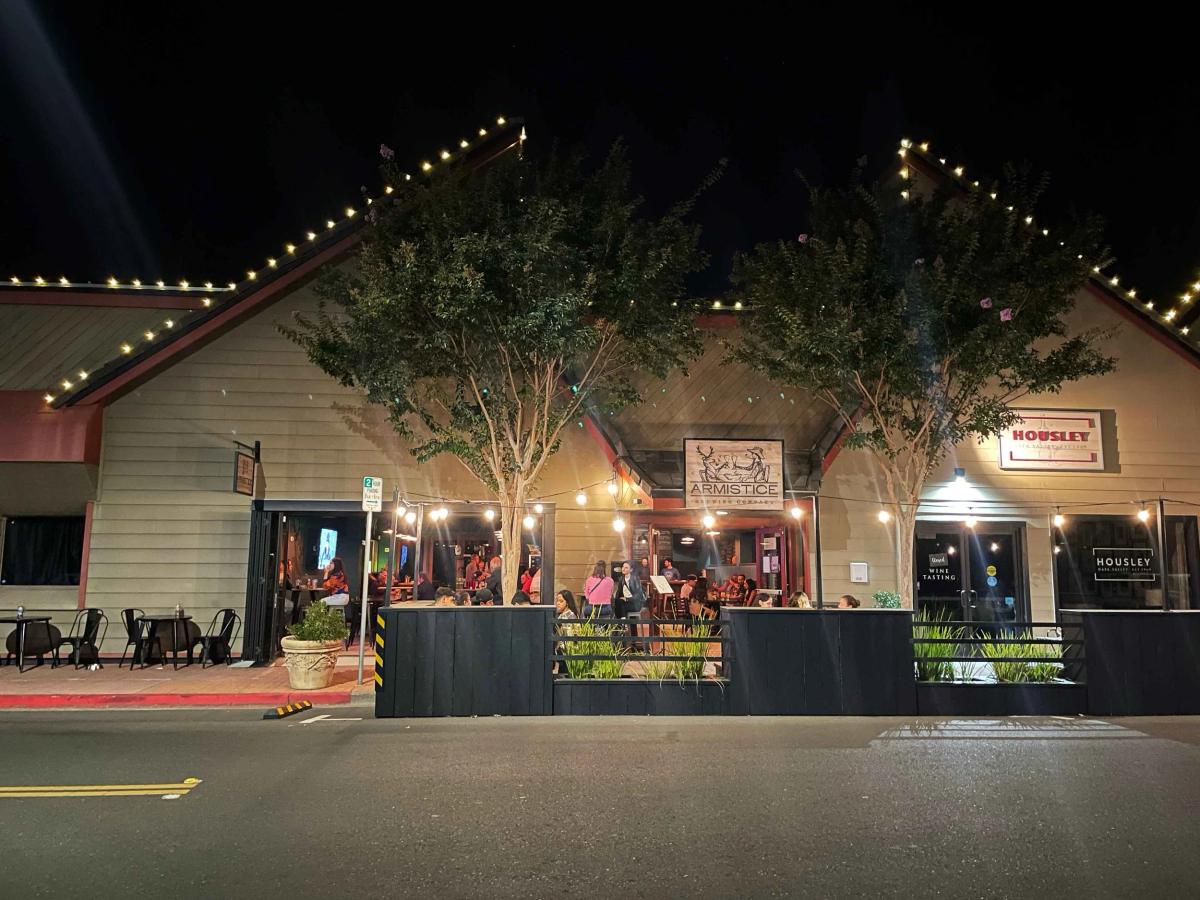
Armistice Brewing Taproom, Richmond, Calif.
But you could also be at Armistice where we’re actually designing the environment for you to understand this beer name as a part of the whole puzzle. In that case, there would be a beer description that pretty much explains it to you, that clues you into the relevant political context if that’s what it is.
You also have personable employees that can help someone find a beer based on their tastes, and really tell the stories behind the names.
That’s the whole thing, right? We’re trying to get you at every level. If you’re a beer nerd and you’re coming in here and you’re looking for a rustic, unfiltered Pilsner, we want to capture your imagination and describe the beer — even if it’s just in the quick-hit style descriptor — in a way that’s going to appeal to you. That’s actually how I usually shop for beers.
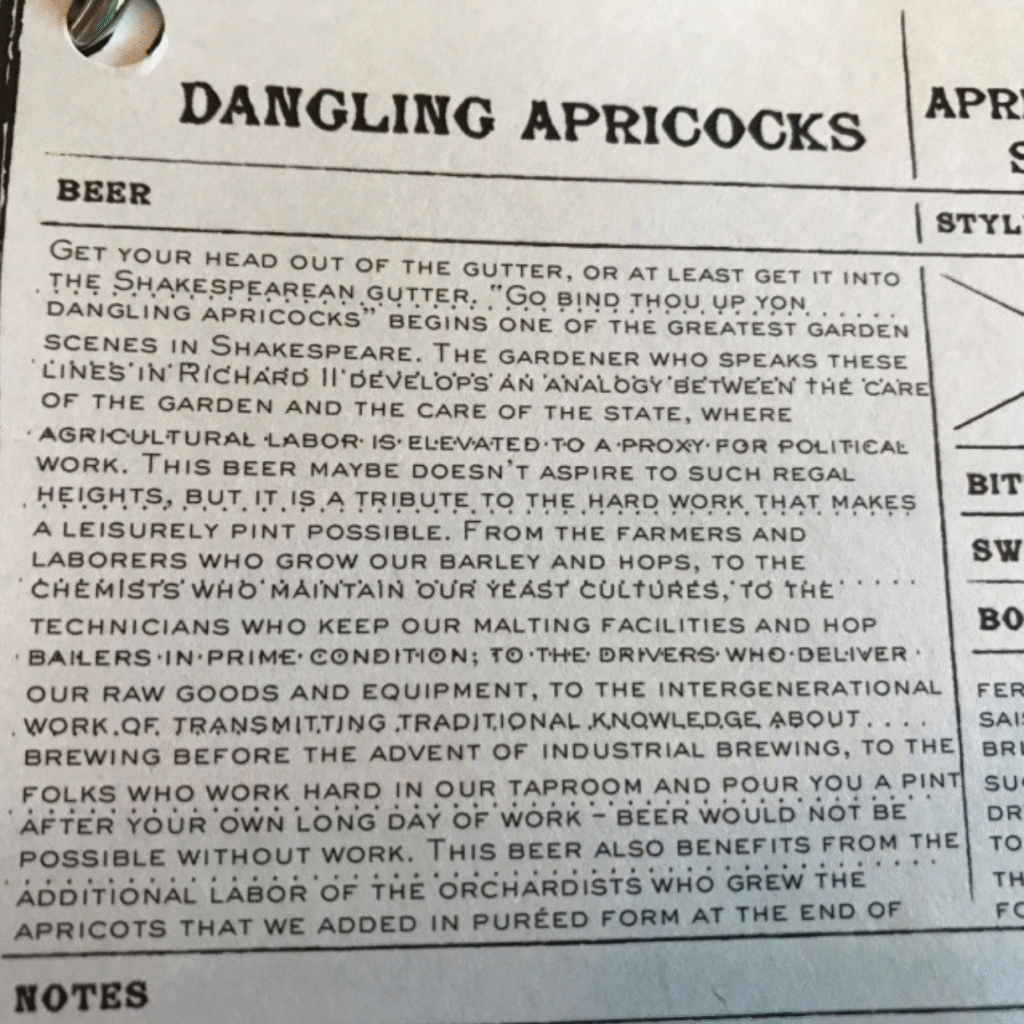
But if you’re not trying to pay attention to beer styles and you see a beer that jumps out at you just because of the name — for example, I remember our “Dangling Apricocks” beer. It was a throwaway name to me. Gregory hated it, but we had so many people that saw “Apricocks” and were like, “Yeah, I want that one!” That beer was actually a turning point for us being like, “Oooh. No offense, Shakespeare, these absurdly-named beers can actually result in a purchase!” Hopefully it’s a good beer because if someone’s just ordering it offhand for the silly name, we want them to order another beer after they’ve finished that one.
If a brewery were to have a “viral moment” with such a beer name, would they typically be able to capitalize on it?
That’s the thing about the “I Dunkeled In My Pants” beer, right? No one’s set up to have a viral moment in beer because it takes a two-year build out and a financing plan that’s five years in advance, as well as thousands, maybe millions, of dollars in stainless steel equipment.
In order to have a beer get national or international notoriety a brewery needs all that lined up?
You have to do that or you have to be willing to quickly pivot to contract brewing and let other people make the beer for you. That’s fine, but if you’re having a viral moment, chances are it’s probably going to dry up just as quickly. It’s a trendy marketplace.
You mentioned before that scaling brewing production is very difficult.
It’s a huge jump and like I said, it can be done with contract brewing if you’re willing to let someone else do it but for you. But this is where — pinkies up — we get snooty. To me, there’s a big difference between taking yourself too seriously in the branding and cutting corners in the production process.
We believe people are going to have a better experience all around if the beer is tasting its best and they’re in an environment where they’re having a good time. That’s all we’re trying to do at Armistice.
You mentioned you’ll have ideas for a name for a beer first and then make it?
Yeah. I definitely have a list — it’s kind of a preferences list. Gregory generally runs the brewery so any of my ideas have to actually make it into the schedule. I can be resentful of that, but it doesn’t really get me anywhere.
So he might say, “We have to have two hazies coming down the pike.”?
That’s always how it happens! That’s always why my ideas get booted to the back.
In regards to the brewing process, when do you most typically name a beer?
Most of the time, it’s the week of release. We usually don’t have to design a label. I think it’s cool — it’s one of the reasons why our beer names tend to be so ephemeral. It’s like, what’s in the news? What are people talking about?
Other times we have a name that we think is really great. It’s super evocative of the beer we’re trying to make, and then we just can’t come up with a visual for it and those languish.
How do you build relationships and collaborations with fellow brewers?
I think you have to vibe with enough people to make it happen — the breweries that we habitually collaborate with are Temescal, Humble Sea, and Cellarmaker. I think a sense of humor is important in any relationship. But I also think a shared sense of values is important. It really depends on the relationship and the people.
What inspires your “beer series” naming? Such as “Fistful of Flowers,” “A Few Flowers More,” and “The Good, The Bad, & The Danky.”
Obviously, the Clint Eastwood films. Honestly, it’s just what gets traction with Gregory. Where we have areas of overlapping interests are a clear green light, gas pedal situation.
What was your beer “Dupontzi Scheme” a reference to?
Dupont is the yeast strain from Brasserie Dupont. I think I can speak for both me and Gregory, when I say it’s one of our favorite saison breweries in the world. They have Saison Dupont and Dupont Foret, the organic version.
What inspired your beers, “Juice Queens” and “Yassberry”?
I’ll just say that at that time I was all about unearthing the queer archeology of these catchphrases. If you read the descriptions for those beers, they talk about ball culture. They felt like opportunities to share learning, highlight this history, and honor the people behind those phrases.
When thinking about naming do you ever ponder types of naming — such as descriptively versus evocatively?
Something that I feel pressured to do with hazy IPAs is to name the beer in a way that’s evocative of the haziness so that people see it and know. Generally when people see the word “juice,” they’re like, “it’s probably hazy.” That’s because hazy beers tend to have higher finishing gravity and read as sweeter on the palate.
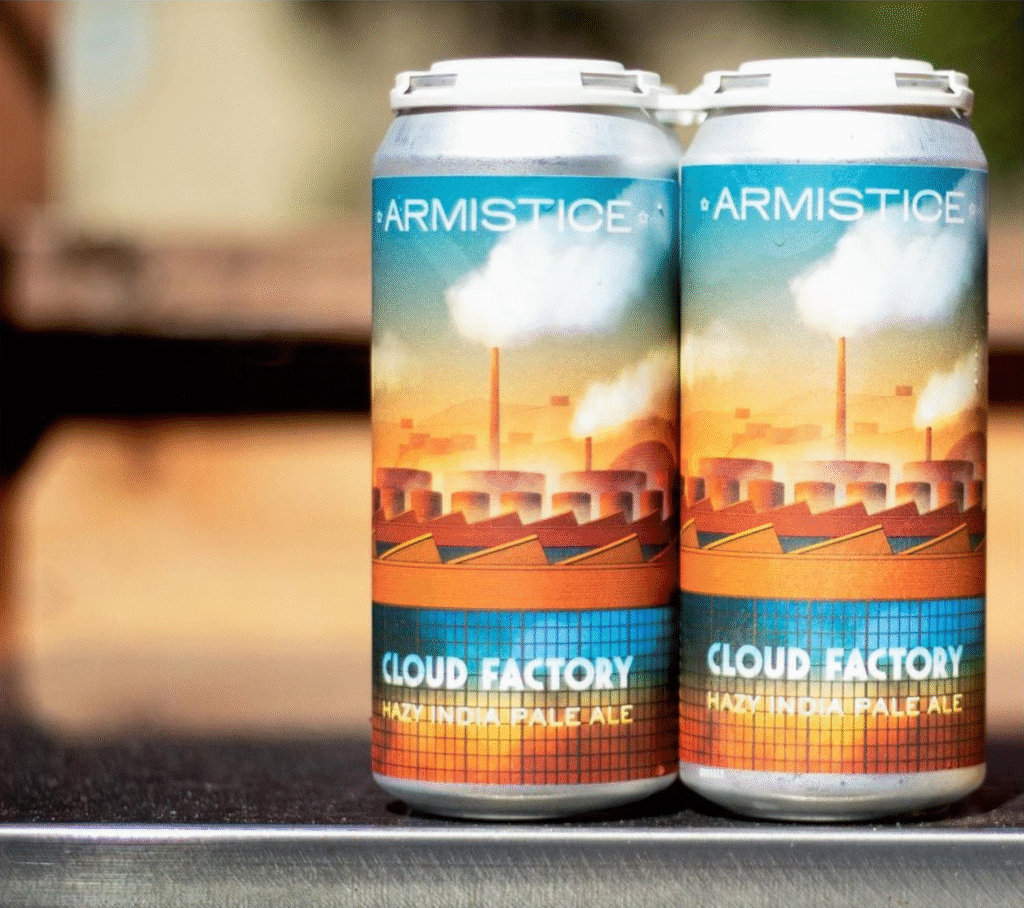
That’s like your “Cloud Factory” or “Fog Harvest”?
Yeah! They’re evocative of being hazy. I’m always trying to get our staff to come up with better vocabulary and language.
Do you ever get tired of a given bar call or a name that you put into the world? Such that it gets overly exaggerated and people are yelling it at you and the team at the taproom?
No, I wish we were that popular that people were like, “Cloud Factory!”
How do you navigate the sometimes raunchy and misogynist humor in beer naming?
Some beer names are made legible — like the misogyny or whatever’s offensive about them — by the combination of their text and iconography or imagery. I’m thinking about a beer named “Hoppy Ending” [by Palo Alto Brewing Company] — it wouldn’t be offensive if the image wasn’t clearly a sexualized Asian masseuse massaging an anthropomorphized hop. It’s like, cool this is making fun of trafficking.
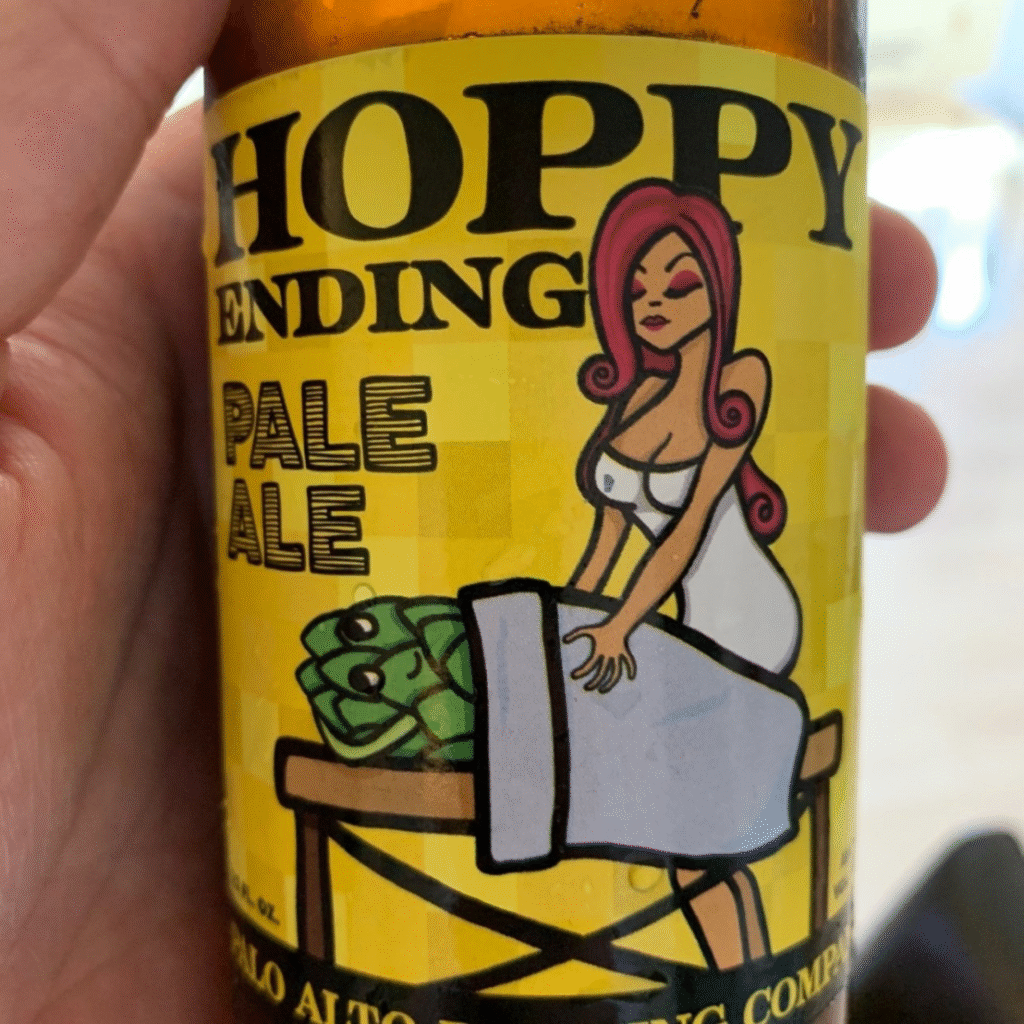
There’s a lot you can do to clarify your meaning or your intentions or whatever. For sure, the author’s intent is neither available nor desirable, but the meaning is a complex of the image and the text. You can control a lot of it. Even in the taproom, if we have a beer that’s in a can, the consumer that has the can actually has imagery to direct their interpretation.
I’ll give you an example of a beer that we currently have in development. I want to do a beer that’s called “Dirtbaggin’.” There are ways that you could render a label that would make it really classist, but there are also ways that you could render a label that would be a class critique. It can easily go from reifying class to critiquing class.
How do you think beer names influence the social moments that involve beer?
It goes both ways. They’re produced by the culture, they produce the culture — they’re reading a script, they’re writing a script, just like everything.
Is there anything else you’d like to talk about regarding humor in your beer naming?
Yeah. I really want to talk about “Slutty Puppy.” I think it’s a really good tension point and a name that I’m still advocating for to be a real beer name. Our friends at Temescal Brewing, they do this Halloween costume contest for dogs. They make a beer for the contest called “Spooky Puppy.” It always has the cutest label with cute dogs in costumes — it’s such a good idea.
I think it’d be really fun to make a beer called “Slutty Puppy” and my idea is that it’s dogs in these stereotypical slutty nurse, slutty nun, slutty whatever, slutty Abraham Lincoln costumes. The idea is “slutty” is such a human concept. My hope, I guess, is that it would be sex-positive, pro-human, et cetera. Then you’d have to definitely think about and iterate on the visual concept…I got feedback that was like, “Maybe you should make it sexy puppy.” I was like, “No!”
I guess we should wrap this up…
Slutty Puppy always ends the conversation.
Thanks to Rose Linke.